Skip to content

Tree Pruning in North Texas with the Right Months and Cuts

  • North Texas tree care guide
  • 6 minute read
  • By Daniel Sanchez, owner, Texas Tree Tops
  • Reviewed

The short answer. Good tree pruning removes only branches that cause a clear problem, such as dead branches, rubbing limbs or a branch on the roof. Most North Texas shade trees should be pruned from late fall through winter, when they are not growing. Do not prune oaks from February through June. Cut just beyond the swollen ring where the branch meets the trunk. Never top a tree.

Pruning trees to fix one clear problem at a time

Good tree pruning removes only branches that cause a specific problem, such as deadwood, crossing limbs or a limb on the roof. Name the problem first, then find the fewest cuts that solve it.

  • Limb on the roof

    We shorten it back to a side branch that points away from the shingles and gutters.

  • Deadwood

    Dead branches come out first. They drop without warning and let decay into the trunk.

  • Crossing limbs

    Two branches rubbing each other open the bark. The weaker one goes.

  • Space below the branches

    Low limbs over the drive or the walk come up so a truck, a mower or a person can pass.

A healthy set of branches provides summer shade that took years to grow. Good pruning leaves most of them in place.

Best time to prune trees in Texas, month by month

The best time to trim trees in Texas is late winter, while most shade trees are dormant and before spring growth starts. Oaks follow their own calendar because of oak wilt, so they are not pruned from February through June.

  • December to February

    Most shade trees are dormant. Bare branches show the structure plainly, and spring growth starts sealing the cuts.

  • February to June

    Oaks wait. Beetles that carry oak wilt are drawn to fresh oak cuts in these months.

  • Late winter

    Crepe myrtles get shaped before the buds break. Our crepe myrtle pruning guide covers the details.

  • August

    AgriLife's Travis County office says to stop most trimming by August, because late new growth can be hurt by an early freeze.

  • Any month

    A cracked or hanging limb comes down when you find it.

A dry summer, hard freeze or new driveway can change the right time to prune one tree. Use the calendar as a starting point, then check the tree's condition.

How to prune a tree where a branch meets the trunk

To prune a tree well, find the branch collar first. It is the slightly swollen ring where a branch meets the trunk, and the final cut sits just outside it.

  1. 1

    Undercut

    For a heavy limb, make a shallow cut from below a short distance from the trunk. This keeps the bark from tearing down the stem.

  2. 2

    Weight cut

    A second cut from the top, a little farther out, drops the limb.

  3. 3

    Final cut

    The short stub comes off just outside the collar. The collar stays whole, and the tree seals the wound from there.

  • Flush cut

    A flush cut is wrong. It slices into the trunk and leaves a larger wound.

  • Long stub

    A long stub is also wrong. The stub dies back slowly and rot follows it in.

  • Back to a side branch

    This cut is right when you need to shorten a limb instead of removing it.

Learn these to judge a plan, not to climb with a saw. Texas A&M Forest Service draws each cut in its mature-tree guide, listed under Sources.

Cutting back trees hard without topping one

Tree topping cuts big limbs back to stubs to make a tree smaller, and it weakens the tree. Topping causes many fast-growing sprouts that attach weakly and can break in the next storm, so Texas Tree Tops does not top trees.
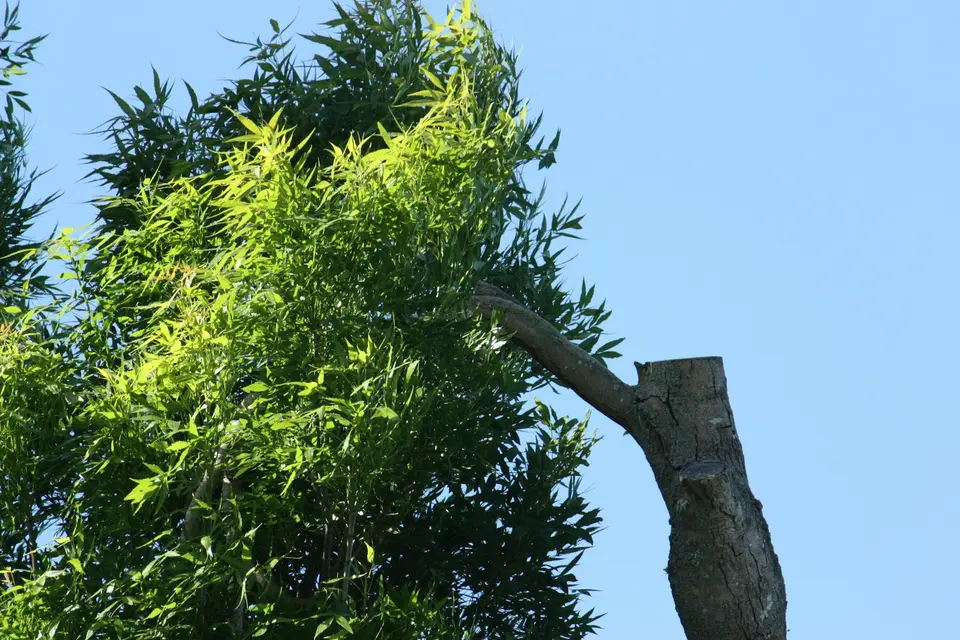
Topped trunk with a dense flush of new shoots beside the cut

Tree topping

Topping leaves stubs, a burst of fast-growing shoots and weaker upper branches within a few seasons. Then you face the same work again.

Cut back the right way

Shorten limbs back to side branches. This keeps the tree's natural shape and reduces repeat work.

If a tree has outgrown its space, careful trimming can buy time, but large tree removal may be the final answer. Cutting it back hard every spring will not keep a large tree small.

Pruning a young tree you can reach from the ground

  • Choose one main trunk

    If two stems compete to become the trunk, they may form a weak fork. Choose one early and shorten the other.

  • Keep some low limbs

    Lower branches feed a thin trunk. Take them off over several years, never in one visit.

  • Hand pruners for thin stems

    A sharp blade cuts clean. Crushed bark closes slowly.

  • Use long-handled cutters only on small branches

    If the tool strains or crushes wood, the branch has outgrown it.

Stop when the job needs a ladder, a chainsaw or a limb you can't control as it falls.

Tree pruning checklist before anyone climbs

  1. Name the tree, or photograph its leaves and bark.
  2. Point to the exact branch and the trouble it causes.
  3. Note when it changed, and whether a storm came first.
  4. List what sits below, such as a roof, fence, pool, cars or beds.
  5. Measure the side gate and flag any soft ground.
  6. Ask how much live canopy comes off, and why.
  7. Agree on cleanup and who removes the cut branches before work starts.

When pruning needs a crew

  • Above your head

    Call a crew for any cut that requires a ladder or climbing into the branches.

  • Over something that breaks

    Limbs above a roof, fence, pool or parked car need ropes so the crew can lower them safely.

  • Near a power line

    Stop and call the utility. Wires belong to them and their contractors.
Best time to prune and other tree pruning questions

When is the best time to trim trees in Texas?

For most shade trees, the best time to trim trees in Texas is late winter, while they are dormant and before new growth starts. AgriLife's Travis County office lists ash, elm, maple and pecan for January and February. Oaks are different, and Texas A&M Forest Service says to avoid pruning or wounding oaks from February through June. A broken limb comes down in any month.

How do you prune a large branch without tearing the bark?

Use three cuts on a heavy limb. Make a shallow undercut a short distance from the trunk so the bark does not tear down the stem, then a weight cut from the top a little farther out to drop the limb. The final cut takes the short stub off just outside the branch collar, and the tree seals the wound from there.

What is the difference between tree trimming and tree pruning?

People often use both words for the same work. Trimming usually means shaping a tree or clearing space, and pruning means choosing certain branches to improve the tree's shape or health. Your estimate should say which branches will come off and the reason for each one.

Is tree topping bad for a tree?

Yes. Tree topping cuts big limbs back to stubs, and the burst of fast-growing sprouts that follows attaches weakly and can break in the next storm. Within a few seasons the upper branches are weaker and the same work comes due again. Texas Tree Tops does not top trees and shortens limbs back to side branches instead.

What part of a tree should not be cut?

Do not cut into the branch collar, the swollen ring where a branch meets the trunk. Texas A&M Forest Service says the final cut goes back to the collar. A flush cut into the trunk makes a larger wound, and a long stub dies back and lets rot in.

How much of a tree can you prune at once?

Texas A&M Forest Service says not to remove more than 25% of a tree's crown at one time. Most healthy trees need far less than that. If a tree needs a lot of work, start with dead and broken branches and spread the rest of the cuts over two or more seasons.

Can trees be pruned in summer?

Yes, they can, within limits. You can remove a dead branch or make a small cut for space in July. Do not reshape a tree that is struggling in August heat, because it needs its leaves, and save major shaping for late fall or winter.

Can you prune trees in the fall?

Yes, late fall works for most North Texas shade trees, because their pruning window runs from late fall through winter while they are not growing. AgriLife's Travis County office says to stop most trimming by August, since late new growth can be hurt by an early freeze. Oaks fit fall pruning too, as long as each oak cut is painted right away.

Tell us which limb needs work

Describe the branch and the shade you want to keep. We will list the cuts and cleanup in a free written estimate.

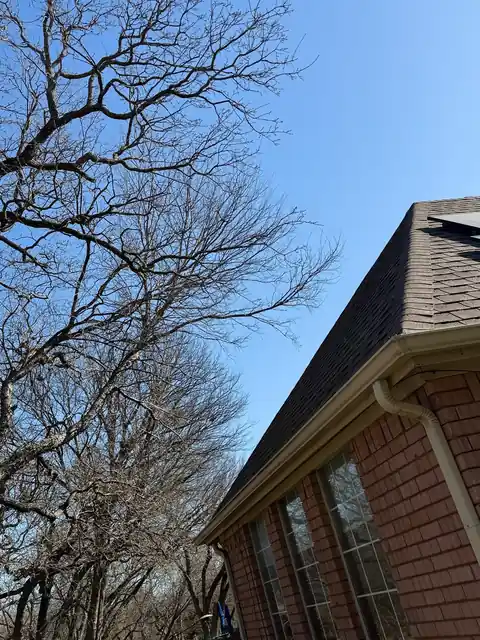
  • A bare tree reaching over the roofline of a brick house
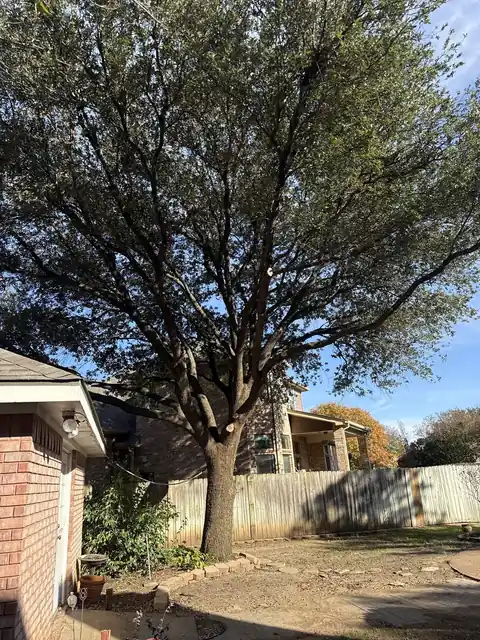
  • A large live oak beside a brick side yard with its lower limbs lifted
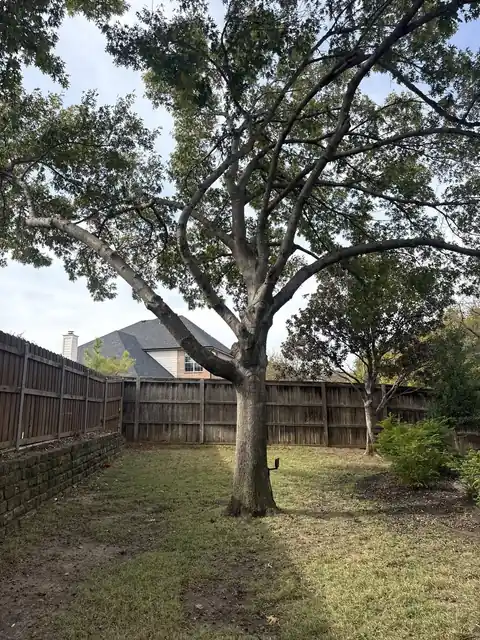
  • A trimmed oak in a fenced backyard over a tidy lawn
Call (682) 708-4984 Free estimate